
Hongke Packaging operates a self-built 11,751.29 m² facility in Longgang, Wenzhou, with cleanroom-standard areas and an independent physical and chemical laboratory. Seal-strength and leak checks address different failure modes and work best as part of a project-specific validation plan.
Follow a pouch from print to converting
Founded in 2003, Hongke Packaging operates on a self-owned 20-mu industrial park. Production equipment includes four high-speed gravure presses with online AI visual inspection, two dry and two solvent-free laminators, two slitters, one rewind inspection machine and twenty automated bag-making machines.
Print inspection helps identify appearance defects. Lamination, slitting, seal setup and fitment assembly introduce their own process variables. Link film, ink, adhesive and converting records to the lot so a discrepancy can be traced and isolated.
Use strength and leakage checks together
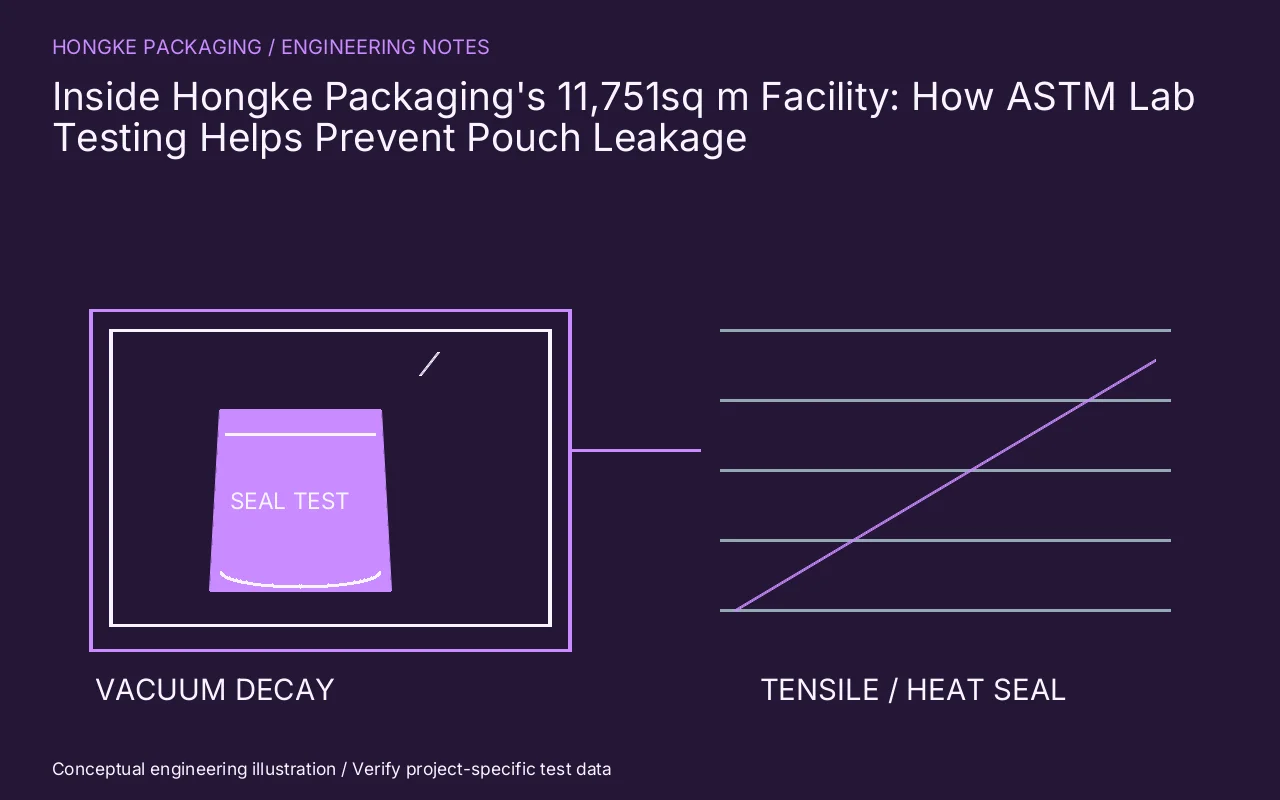
ASTM F88/F88M measures seal strength under a specified specimen and pull configuration. A strong average can coexist with an occasional seal channel. Leak methods evaluate an integrity question instead. The method, sensitivity, fixture and fill must be selected for the pouch construction and the defect to detect.
Inspect spout interfaces, gusset corners, zipper ends and seal intersections separately. Check how process changes, product contamination, storage and distribution affect those points. Verify the sampling and acceptance plan on representative units, with the customer’s filling conditions included where relevant.
Ask for evidence appropriate to the order
Request the approved material, accepted drawings and test conditions alongside the agreed release records. Where food contact is involved, verify the exact structure and intended use. A method reference explains how a check is performed. It does not independently certify a pouch or prove suitability for every application.
Packaging specification comparison
| Specification | Where it matters | What to confirm |
|---|---|---|
| Seal strength | ASTM F88/F88M where applicable | Record sample width, pull configuration, force and failure mode |
| Package integrity | Suitable leak method such as validated vacuum decay | Define sensitivity, fixture, controls, fill and target defect size |
| Material and barrier | PET/AL/PE or approved alternative | Record gauge in μm, OTR/WVTR conditions and structure approval |
| Order acceptance | Final drawings, release plan and commercial scope | Confirm per-SKU MOQ, lead time, sample plan and order-specific documentation |
Why Choose Hongke Packaging
- Self-built Wenzhou facility with dedicated cleanroom-standard areas.
- Independent lab with tensile, heat-seal, barrier and leak test equipment.
- ISO 9001 and BRCGS Packaging certifications and project-specific food-contact review.
Explore custom pouches · Download dielines · Request a stock sample kit
Final Thoughts
Specify the failure mode, choose a suitable method and agree on acceptance before the run. Traceable lot and test records make a seal or leak investigation much easier to resolve.
Frequently asked questions
Does a strong seal mean there are no leaks?
No. Seal-strength and leak checks answer different questions. Use both where appropriate to the product and risk.
Is the whole 11,751.29 m² facility a cleanroom?
The figure is the area of the self-built facility. It includes designated cleanroom-standard areas.